
With the first introduction of ICAO aviation security Standards in 2005, States and industry groups have been discussing One-Stop Security (OSS) and its potential to improve aviation security and facilitation globally. As international traffic continues to grow, the industry needs security provisions that are robust while avoiding unnecessary duplication for transfer passengers and baggage.
Repeated screening at transfer points consume additional resources without necessarily adding security value when equivalent measures have already been applied at the point of departure. It drives longer connection times, increases system loads for transfer baggage, and requires airports to dedicate extra space, staff, and equipment to re-screening. This capacity could be used to focus on higher-risk activities and improve overall performance.
One-Stop Security addresses this challenge directly. It allows eligible passengers—and where applicable, baggage and cargo—screened at the point of departure to transfer without being re-screened, provided States formally recognize each other’s security measures as equivalent.

What is One-Stop Security (OSS)?
One-Stop Security (OSS) is an agreement where passengers, baggage, and cargo screened at the departure point in a designated airport in one State are not re-screened at transfer points in another designated airport in another State, provided both States formally recognize each other’s security measures as equivalent. Built on ICAO standards, in particular Annex 17, OSS strengthens
aviation security by promoting efficient application of security measures, while making passenger journeys more seamless and efficient.
From “Why OSS” to “How OSS”
To support practical implementation, ACI World has published an updated One-Stop Security Toolkit, designed to move the conversation from why One-Stop Security matters to how airports can implement it in practice.
The toolkit aligns with ICAO Annex 17 and ICAO guidance material published in 2023, and provides airport-focused guidance, real-world case studies, and airport-oriented templates that can be adapted for local airport environments.
Why One-Stop Security is critical now
One-Stop Security is not only about speed. It supports stronger security outcomes by promoting alignment and information exchange between States, while reducing inefficient duplication at transfer points.
The toolkit reinforces that One-Stop Security should be viewed as both a facilitation and a performance measure for airports. It can relieve pressure on checkpoints and baggage systems by allowing eligible passengers and bags to transfer directly, freeing capacity for other travellers and reducing congestion at screening points.
The strategic benefits of One-Stop Security for airports
The toolkit frames One-Stop Security as “both an opportunity and a responsibility,” and sets out practical benefits that airport executives, operations leaders, and security managers can translate into business cases:
- Efficiency gains: Reduced duplicate screening can lower operational burden and allow resources to be allocated more effectively.
- Improved passenger experience: Smoother transfers and shorter queues enhance reliability and service quality, key drivers of hub preference.
- Hub competitiveness: One-Stop Security can support connectivity strategies by making transfer itineraries more attractive to airlines and passengers.
Importantly, One-Stop Security is not purely an Aviation Security (AVSEC) focus at airports. Passenger flows, passenger dwell times, and access to retail and duty-free areas may change, meaning that commercial and customer experience teams within airport departments should be engaged early.
A reality check: One-Stop Security is State-led and it is dynamic
Airports can champion OSS, but formal recognition of equivalence rests with States. Airports succeed when they support that recognition through evidence, operational readiness, and day-to-day compliance.
The toolkit explains OSS within the ICAO framework, including requirements related to transfer passengers and baggage, flow integrity, and the prevention of mixing screened and unscreened passengers without re-screening. National risk contexts can change, however, and equivalence arrangement can shift or be suspended, and airports must be ready to adapt procedures, and passenger flows quickly to remain aligned with State requirements.
Practical tools airports can use immediately
Airport-facing resources in the toolkit are particularly valuable for turning interest into action:
- Template letter to State authorities: Helps airports initiate OSS discussions in a way that aligns with regulatory decision-making processes.
- Security measures comparison matrix: Supports benchmarking of compatibility with potential OSS partner airports and prioritization of feasible routes.
- OSS readiness checklist: Assists airport operators in aligning security, operations, IT, terminal planning, and commercial teams ahead of implementation.
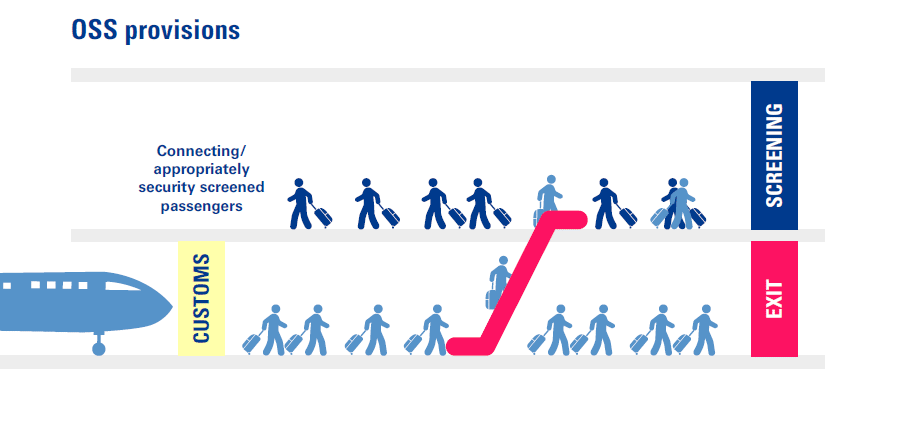
The toolkit also provides guidance on infrastructure and terminal design, particularly the need to maintain segregation between One-Stop Security eligible passengers and those who require re-screening, using dedicated corridors, vertical separation, swing gates, or procedural controls where appropriate.
The toolkit highlights case studies that illustrate the level of coordination required across regulators, airlines, and airports, and the practical solutions used to enable facilitation while maintaining commensurate security outcomes.
From interest to implementation: a call to action for airports
One-Stop Security works best when airports, States, and other relevant stakeholders collaborate to balance facilitation with effective security provisions. The toolkit encourages airports to engage early with national regulators, collaborating with stakeholders to identify best cases where One-Stop Security provides the greatest benefit.
related articles



comments