
How ACI is Rethinking Traffic Forecasting in a Post-Recovery World
Organization: ACI World
Core report: World Airport Traffic Forecast (WATF) 2025–2054
Industry: Airports and air transport
Focus: Airport traffic forecasting in a post-pandemic world
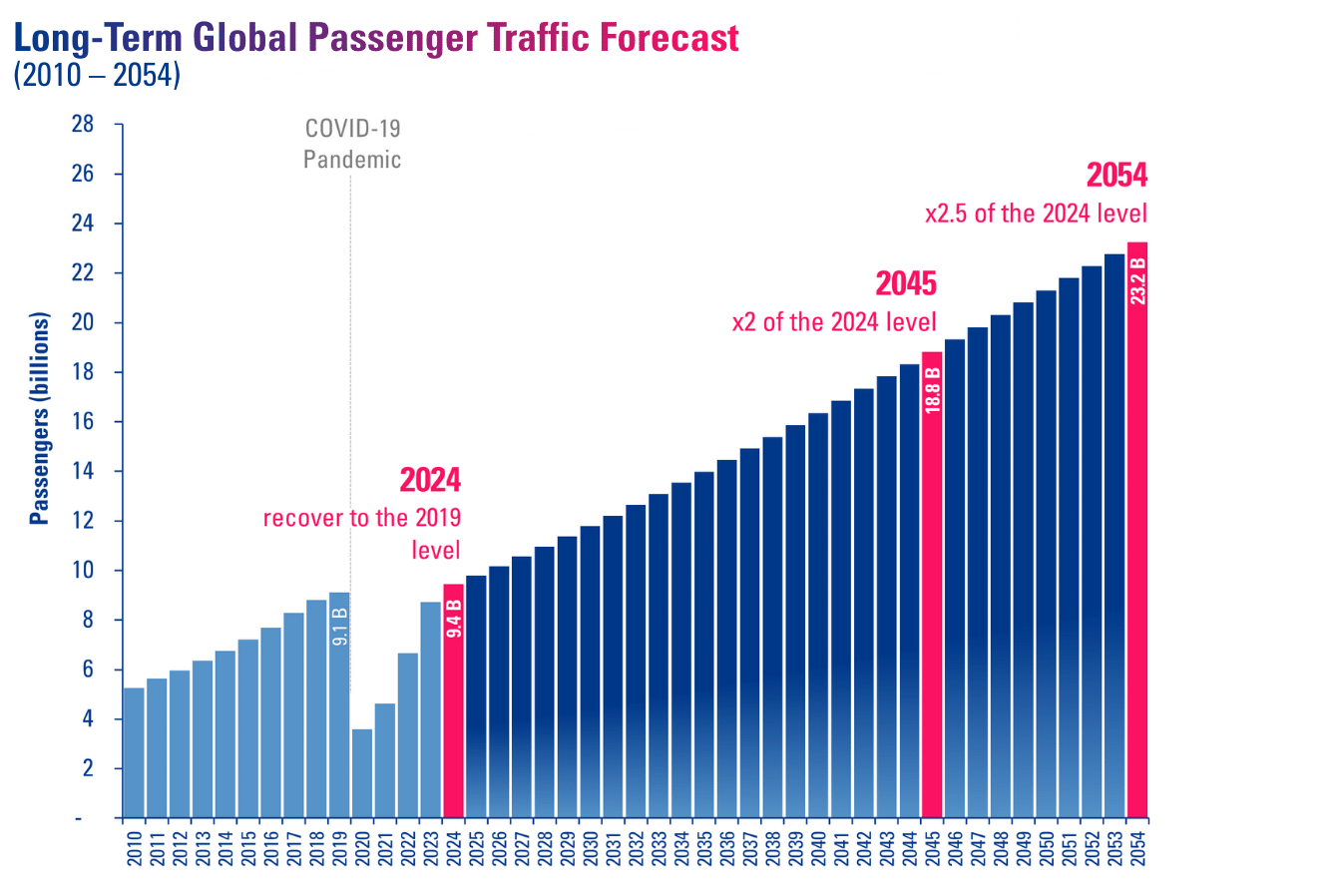
ACI World has just released the World Airport Traffic Forecasts (WATF) 2025–2054, presenting a new 30-year outlook on global passenger, cargo, and aircraft movement demand. The headline message will not surprise many in the industry. Long-term demand for air travel remains strong. At the same time, growth is becoming increasingly uneven across regions and more constrained by capacity, infrastructure, and operational complexity.
Why forecasting has changed since the COVID-19 pandemic
For those of us working closely with the forecast, however, the release represents more than a new dataset. It is also a moment to pause and reflect on how forecasting itself has changed, and how its role within aviation continues to expand well beyond projecting demand.
Forecasting is often assumed to be about predicting the future. In practice, it is about making sense of uncertainty, particularly when the past no longer behaves as expected.
Market Differences in Global Airport Passenger Traffic
Few periods have tested this more than the years following the COVID-19 pandemic. When global air traffic collapsed, historical patterns that had guided aviation forecasting for decades offered little help. Recovery paths varied widely by region, market structure, and passenger mix. Factors such as public health policy, geopolitics, and supply-chain disruption suddenly mattered as much as traditional economic drivers.
ACI World forecasting during this period was not simply about updating numbers. It required rethinking how forecasts are built, tested, and interpreted. As the industry moves into a post-recovery phase, a new question now comes into focus: if recovery is largely complete, what comes next?
What is the ACI World Airport Traffic Forecasts?
The World Airport Traffic Forecasts has long been a core part of ACI World’s analytical work. It is not, however, a static product. Each edition reflects lessons learned from previous cycles and from changes in the industry itself.
Over time, the WATF has evolved into a more sophisticated and flexible forecasting system. Today, it combines long-term macroeconomic relationships with short-term time-series dynamics, using ensemble approaches that balance structural trends with near-term responsiveness. This allows the forecast to remain anchored in economic fundamentals while still reacting to rapid shifts in market conditions.
Coverage has expanded alongside these methodological developments. The recent edition covers 175 global markets, representing over 97 percent of worldwide passenger traffic. This matters because global aggregates often hide important differences beneath the surface. While overall recovery trends may appear similar at the global level, market-level stories can look very different. Domestic versus international travel patterns, regulatory frameworks, airline strategies, and infrastructure constraints all shape outcomes in ways that headline numbers alone cannot capture.
To help address this, recent WATF editions include qualitative assessments of post-COVID market divergence. These insights add context to the data, helping users understand not only how much traffic is expected to grow, but also why growth trajectories differ across regions.
How ACI World builds and tests traffic forecasts
Scientific, transparent, and continuously tested by design.
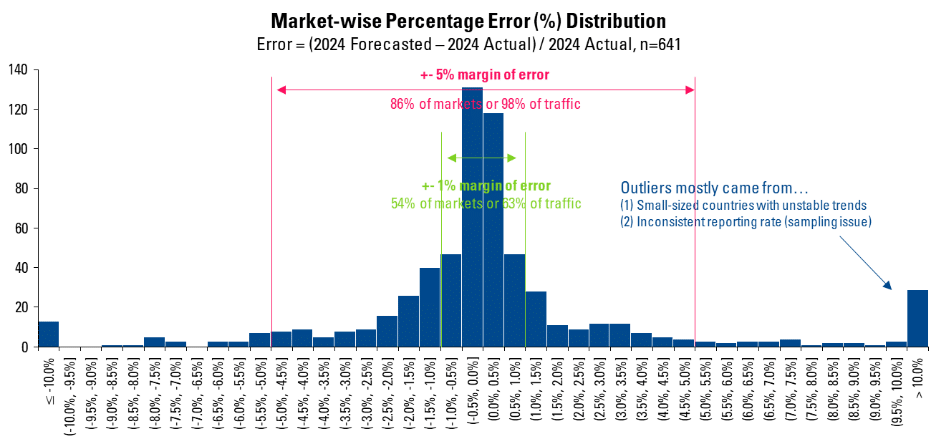
Behind the scenes, ACI World’s forecasting places strong emphasis on scientific rigor and transparency. Methodologies are documented openly, reviewed continuously, and tested against observed outcomes.
This approach extends beyond internal processes. ACI World actively engages with the academic and research community, presenting its work at forums such as the TRB (Transportation Research Board)1 2 and the ATRS (Air Transport Research Society)3. These exchanges provide valuable peer feedback and help ensure that forecasting approaches remain aligned with advances in aviation economics, forecasting practice, and data science.
At its core, ACI World’s analytical leadership in forecasting is about storytelling. Not storytelling driven by novelty or technology alone, but narratives built through layered thinking, cross-validation, and careful interpretation. Forecasts are developed by testing signals across multiple data sources, methodological lenses, expert insights, and system-level constraints. The goal is to ensure that the resulting narratives are robust enough to inform both industry decision-making and policy discussions.
Transparency also shapes how forecasts are evaluated. Each WATF edition includes retrospective accuracy assessments and disclosed error margins. Forecasts are not treated as definitive predictions, but as evidence-based estimates that improve through testing, challenge, and refinement. In an environment defined by uncertainty, this discipline is essential for maintaining credibility and trust.
What this means for airports
• Post-pandemic uncertainty has increased the importance of flexible and scenario-based forecasting.
• Capacity, infrastructure, and operational constraints are now central forecasting inputs.
• Regional divergence requires market-specific planning within a global context.
• Long-term traffic forecasts support airport investment prioritization and data-driven decision-making.
From forecasting volumes to forecasting value
As global traffic patterns stabilise and long-term demand comes back into focus, the role of forecasting is shifting once again. Understanding how much traffic airports will handle remains essential, but it is no longer enough on its own. The real challenge now lies in interpreting what those traffic trajectories imply for airport business models, financial resilience, and long-term system planning. This is where forecasting moves beyond volumes and into value.
Part 1 focuses on how airport traffic forecasting has evolved in the post-pandemic period. In the next article we will examine how these forecasts are increasingly translated into airport revenues, capital investment planning, and long-term system resilience.
Key takeaways
• Long-term global air travel demand remains structurally strong in the post-pandemic environment.
• Airport traffic recovery paths differ significantly by region, market structure, and passenger mix.
• Forecasting has evolved from demand projection to uncertainty management and strategic interpretation.
• The ACI World Airport Traffic Forecasts integrate economic fundamentals with post-pandemic market divergence.
References
1 Jung, H. (2026, January), Forecasting global airport revenues and capital investment: Integrating traffic, commercial trends, financial KPIs, and investment needs. Presented at the Transport Research Board 105th Annual Meeting, Washington, DC, United States.
2 Jung, H. (2025, January), ACI World airport traffic forecasting methodology. Presented at the Transport Research Board 104th Annual Meeting, Washington, DC, United States.
3 Jung, H. (2025, July), Forecasting the new normal: Modeling the recovery and post-COVID growth of global airport traffic. Presented at the 28th Air Transport Research Society (ATRS) World Conference, Hong Kong SAR, China.
related articles




comments