

Building on Part 1, which examined how airport traffic forecasting has evolved in the post-pandemic environment, Part 2 explores how these forecasts translate into airport revenue performance, capital investment decisions, and long-term system resilience.
Key takeaways
• Airport traffic forecasts increasingly inform revenue modelling and capital investment planning.
• Revenue recovery does not always move in line with traffic recovery.
• CAPEX forecasting is directly linked to long-term demand and infrastructure constraints.
• ACI World’s analytical work connects traffic, finance, and infrastructure as part of an integrated aviation system.
How does passenger traffic translate into airport revenue?
Passenger traffic is only one part of the airport story. As airports operate as increasingly complex businesses, understanding how traffic translates into financial performance has become equally important.
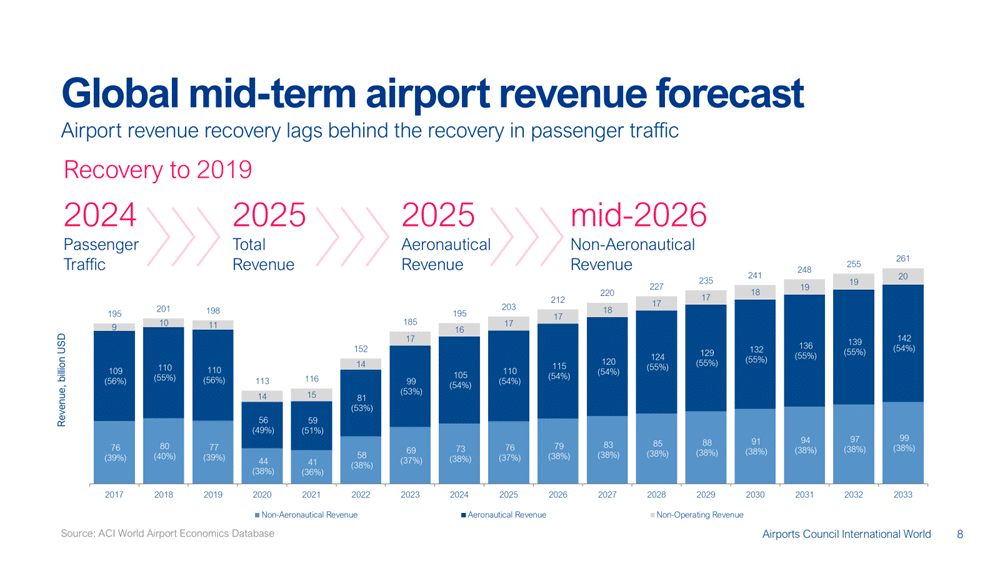
ACI World’s revenue forecasting builds directly on traffic projections, linking passenger demand to revenue per passenger across:
- Aeronautical revenue
- Non-aeronautical revenue
- Non-operating revenue streams
A key insight is clear: Revenue recovery often lags traffic recovery.
Changes in passenger mix — particularly between domestic and international travel — can materially affect financial performance, even when overall volumes appear strong.
Initially developed as an experimental exercise, ACI World’s global airport revenue forecasting has matured over time, and recently featured at the Trinity Forum, the world’s most influential airport commercial revenues and travel retail gathering (2026, Doha). Continuous validation against observed financial data through the ACI World Economics Report and Airport Key Performance Indicators (KPIs) has refined assumptions and strengthened accuracy, demonstrating the value of connecting traffic trends with commercial and financial dynamics.
The objective is not to replace airport-specific financial models, but to provide a global, comparative framework that supports discussions on financial sustainability, commercial strategy, and long-term planning.
How are traffic, revenue, and investment connected?
Traffic, revenue, and investment should not be treated as separate analytical exercises. They form part of a interconnected system.
As passenger demand grows and revenues stabilize, infrastructure capacity becomes a binding constraint in many regions. At the same time, airports face additional investment pressures linked to decarbonization, resilience, evolving passenger expectations, and operational modernization.
These dynamics raise critical questions:
- Where are infrastructure gaps emerging?
- How large are projected capacity shortfalls?
- How do investment needs differ between regions and development stages?
ACI World is preparing to revisit global airport capital expenditure (CAPEX) forecasting to reflect current realities. This next phase will go beyond aggregate totals to examine:
- Greenfield vs. brownfield development
- Regional investment patterns
- Socio-economic implications, such as employment, economic growth, and sustainability objectives
CAPEX forecasting is a continuation of the same analytical narrative. It is about understanding how demand, revenue, and infrastructure interact together over time.
Why does airport forecasting require industry collaboration?
Forecasting does not happen in isolation. Data and models matter, but context matters just as much. Within ACI World, the AT3 (Air Traffic Think Tank) subcommittee featuring 211 members from 92 airport operators provides a member-driven forum for qualitative insight into:
- Market divergence
- Emerging risks
- Shifts in passenger behaviour
- Operational constraints
While individual forecasts are not shared, these discussions inform assumptions and challenge prevailing narratives.
Collaboration extends beyond ACI membership. Engagement with organizations such as ICAO and other industry partners supports alignment on data, methodology, and long-term outlooks.
Often, the most valuable insight does not come from a new dataset — but from questioning existing assumptions.
How is airport forecasting evolving?
As aviation moves beyond recovery, forecasting is evolving from demand estimation to system-level decision support.
Long-term traffic forecasts inform environmental planning and policy discussions (including ICAO’s Long-Term Aspirational Goal and ATAG’s Waypoint 2050). In practical terms, forecasts help clarify:
- Where traffic is likely to grow
- How fast it may expand
- Under what economic and policy conditions growth may occur
Forecasts underpin capacity-building efforts, not only in infrastructure but also in people, helping the industry anticipate future workforce needs in terms of scale, geographic distribution, and required skill profiles.
From an operational perspective, traffic growth raises important questions about how to manage higher volumes amid congestion, climate impacts, evolving passenger expectations, and technological change. In this context, forecasts help frame emerging pressures and trade-offs, supporting more informed decisions on capacity, resilience, and efficiency.
Aviation does not operate as a collection of isolated segments. It functions as a tightly interconnected system. Improving the relevance and usefulness of future analytics increasingly depends on understanding how different domains interact, from air traffic management and airport infrastructure to airlines, manufacturers, ground handling, and service providers. Decisions made in one part of the system inevitably shape outcomes elsewhere.
Forecasting, ultimately, is not about predicting a single future. It is about building shared understanding of the forces shaping aviation, and enabling better decisions across the entire system.
As W. Edwards Deming noted, “Without data, you’re just another person with an opinion.” This principle underpins ACI World’s integrated forecasting approach, which connects traffic, revenue, and investment analysis to provide a transparent, evidence-based foundation for long-term aviation decision-making.
ACI World’s integrated forecasting approach connects traffic demand, airport revenue performance, and capital investment planning to support long-term system-wide aviation decisions.
related articles





comments