

For most airports, the airport passenger experience management begins with a satisfaction score. Satisfaction surveys arrive quarterly. Complaint logs fill up. Scores get reported. Yet the gap between collecting feedback and genuine airport customer understanding remains wider than many realize.
Airport customer understanding begins with the Voice of Customer (VoC), the full range of feedback passengers share, both structured and unstructured, solicited and unsolicited. It extends beyond the terminal, from the moment a traveller plans a flight through departures, arrivals, and commercial areas.
This article is the second in a series exploring the pillars of airport experience management, building on the article: The 8 Pillars of Airport Experience Management: From Fragmentation to Orchestration.
It also follows progression from basic demographic classification, through behavioral behavioural segmentation, to the persona, a data-grounded character with a name, goals, and an emotional arc. This is the first pillar of airport experience management because everything else, strategy, service design, operational improvement, depends on it.
What is airport customer understanding?
Airport customer understanding is not what airports know about their passengers. It is the organizational capability to keep learning, systematically, continuously, and in ways that change decisions.
Airport customer understanding is the organizational capability to systematically learn who passengers are, what they expect, and what shapes their experience at every journey stage – from trip planning through arrival. It combines structured satisfaction surveys, direct observation, employee insights, and persona-based analysis into a continuous learning system that drives operational and strategic decisions.
This article draws on the experience of two airports at the forefront of this work. Kempegowda International Airport Bengaluru (BLR) and Vienna Airport (VIE), both participants in the ACI ASQ program and accredited under the ACI Airport Customer Experience Accreditation, have shared their approaches to illustrate what systematic customer understanding looks like in practice.
Key takeaways
- A listening architecture that triangulates satisfaction surveys, qualitative observation, and employee insights reveals what no single source ever could.
- Observation and employee engagement surface what surveys miss: the unvoiced frustrations, hidden friction, and operational gaps that shape the passenger experience.
- Personas, the most developed form of segmentation beyond basic classification, make it possible to design for real passengers.
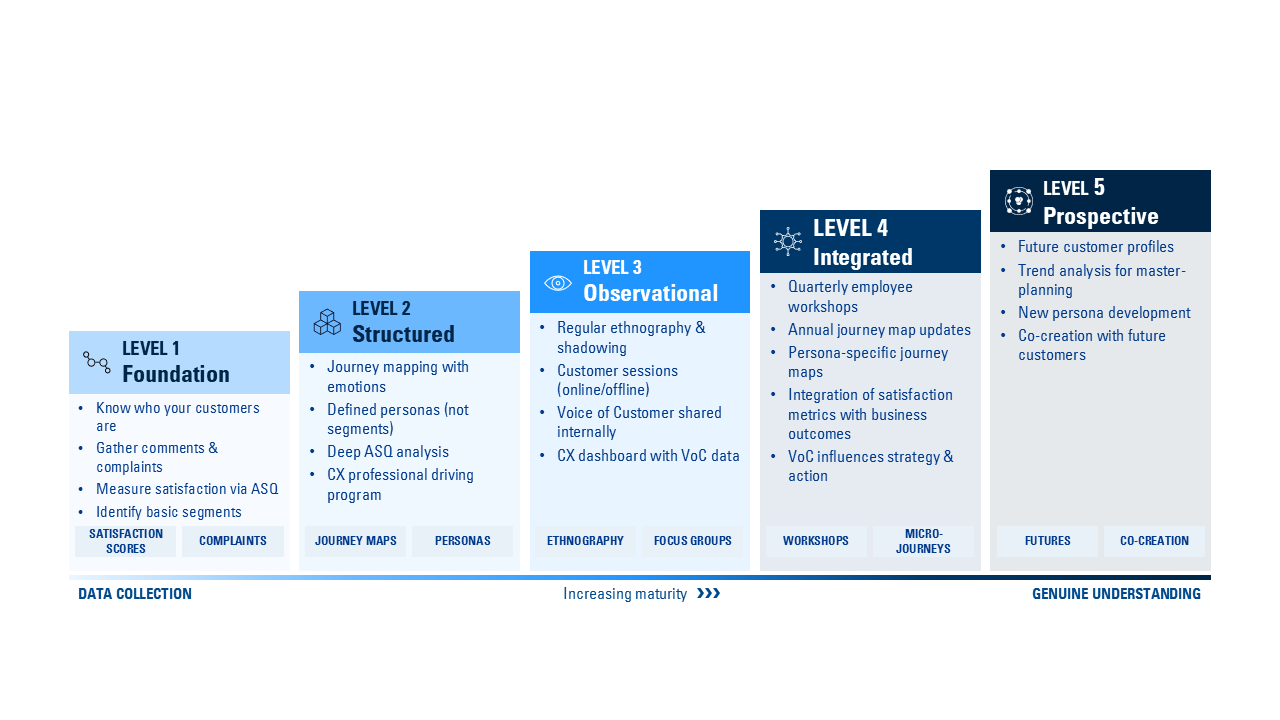
- The Customer Understanding Maturity Spectrum helps airports assess where they are and plan their next steps.
What does airport customer understanding require?
Collecting data is a starting point, not a destination. Turning VoC into genuine understanding requires sound methodology, disciplined sampling, and rigorous analysis. Three capabilities separate airports that report scores from those that act on insight.
Capturing what passengers cannot say: The smaller frustrations that shape perception, hesitation at an unfamiliar junction, confusion over signage, the anxiety of a tight connection, only emerge through direct observation. As BLR puts it, “Customer understanding is not only about feedback. It is also about observing and acting on what passengers experience.” Tracking congestion through CCTV tells you about volumes. It does not tell you about people.
Differentiating between passenger types: A family with young children and a frequent business traveller walk through the same terminal but live fundamentally different journeys. The airports leading in customer understanding move beyond classification through behavioural segmentation to personas, and use them actively in training, service design, and improvement planning.
Maintaining currency: Expectations shift. Infrastructure changes. Without a structured refresh cycle, customer journey maps and personas quietly become historical artefacts.
Building a listening architecture for airport customer experience
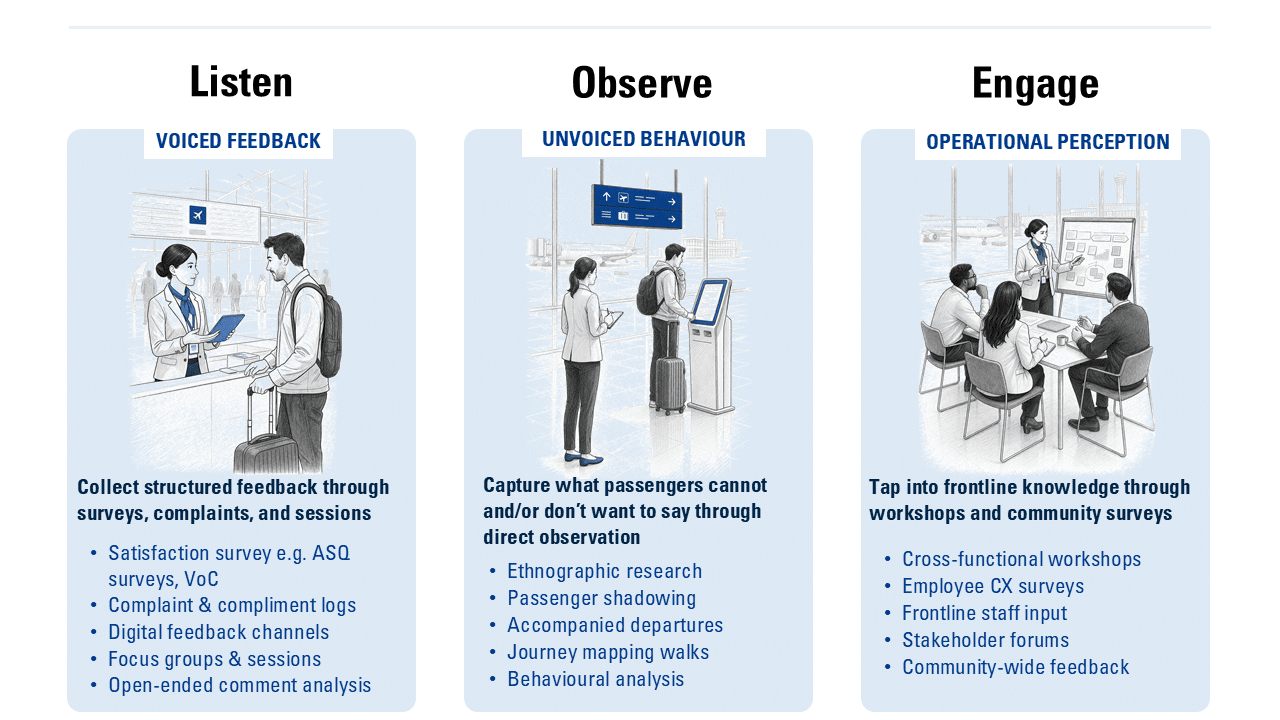
No single method delivers complete airport customer experience insight. What works is a listening architecture: a deliberate mix of complementary approaches that together reveal what no single source ever could.
Turning the voice of airport customer into strategic intelligence
Satisfaction surveys form the quantitative backbone of any listening architecture. When grounded in sound methodology, they provide statistical power, trend analysis, and the ability to benchmark across time and peer groups.
The ACI ASQ program surveys over 700,000 passengers annually across more than 400 airports. But raw scores only show where airports rank. The real value emerges when airports move beyond descriptive statistics to treat ASQ as strategic intelligence, asking not just what passengers scored but why and what drives their satisfaction.
BLR reads ASQ through strategic priorities: seamless travel, trust, accessibility, and service consistency. “ASQ helps us interpret the data in the right context and focus on the measures that matter more for the strategic priorities,” the team explains. These insights feed directly into queue management, wayfinding enhancements, accessibility upgrades, and service recovery training.
Vienna Airport segments ASQ scores and open-ended comments by persona, making it possible to see which passenger types are satisfied at which touchpoints and which are not. These insights feed directly into annual journey map updates.
What works best is triangulating satisfaction surveys with qualitative sources, including observational findings, employee engagement surveys, complaint analysis, and customer sessions. Quantitative methods provide statistical power across the full passenger base, while qualitative methods provide the depth to understand individual experiences. Each complements the other.
The Listening Architecture
No single method delivers complete customer understanding
Observing airport passengers in their natural environment
Observation moves customer insight from what passengers say to what they actually do. Surveys operate on a scale. They capture what passengers say they want and, through predictive models, what their actions suggest they prefer. But they cannot reach the why behind a score. Observation can. It captures real behaviour: the pause at an unknown turn, the confusion over signage, the stress written on a face. It trades scale for depth, and how that depth is captured matters.
Two established approaches bring different strengths. Non-participating observation places researchers in the operational environment to watch travellers without making their presence felt, surfacing natural behaviour and inconveniences that no survey records. Participating in observation pairs a researcher directly with a passenger to shadow their full journey, conducting structured check-ins at each major stage to capture stress levels, emotional states, and process satisfaction.
BLR Airport embeds researchers across the terminal at different journey stages, watching how travellers navigate check-in, security, wayfinding, and boarding. These observations surface patterns that structured feedback cannot, including recurring points of hesitation, misread signage, and unspoken frustrations that shape overall perception.
Vienna Airport conducted 19 accompanied departures over three months in 2025, shadowing passengers pre-selected to match specific personas from curbside to boarding. Structured surveys after each major stage capture stress levels, emotional states, and process satisfaction, building richer individual narratives tied to specific personas.
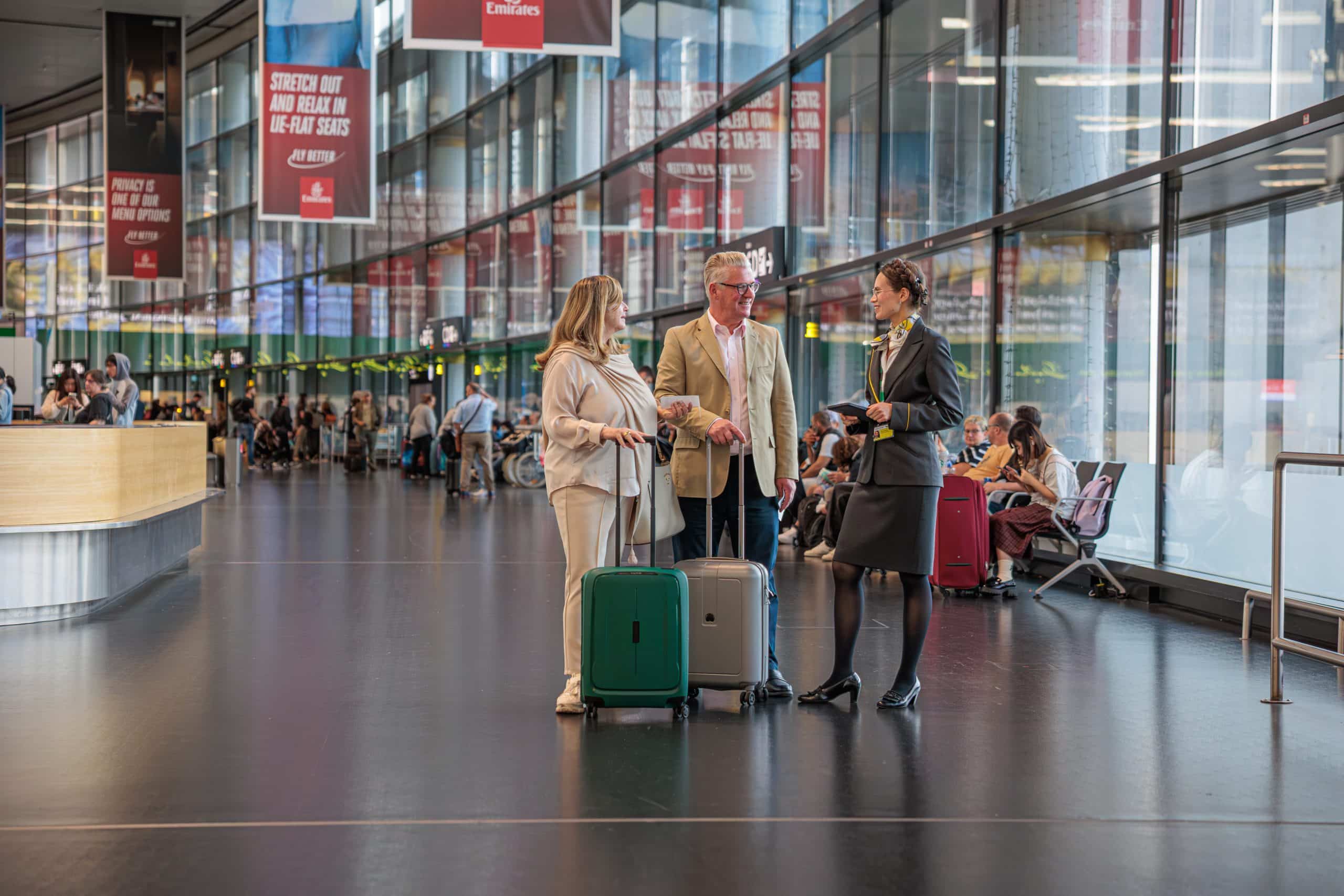
The power is in the layering. A passenger might clear security with no delays yet report elevated stress over an uncertain connection time. That gap between process delivery and passenger feeling is where understanding needs to go.
Engaging airport employees as experience sensors
Frontline staff see things external research never will, including which questions passengers ask five times a day, which signage confuses, and where smooth processes quietly frustrate people. The airports that get the most from employee insight extend the conversation beyond the customer experience team, bringing in operations, terminal management, IT, and even finance.
Vienna Airport formalizes this through quarterly cross-functional workshops, convening dozens of participants from across departments and subsidiaries to map the general journey and key touchpoints such as check-in, security, and connecting passengers. The practice has already delivered concrete improvements, from a terminal infrastructure overview map for the contact center to a conversational AI agent for wayfinding.
BLR Airport has taken this further, surveying its entire airport community. Over five months in 2025, 2,084 respondents from airlines, subcontractors, concessionaires, and security companies completed an Employee Customer Experience survey with a 78% response rate. By comparing employee perceptions against passenger-reported ASQ data, BLR surfaces where operational reality and passenger perception diverge. This comparison also reveals employee engagement levels, where a perception gap exists, it signals both a service gap and an opportunity to strengthen engagement.

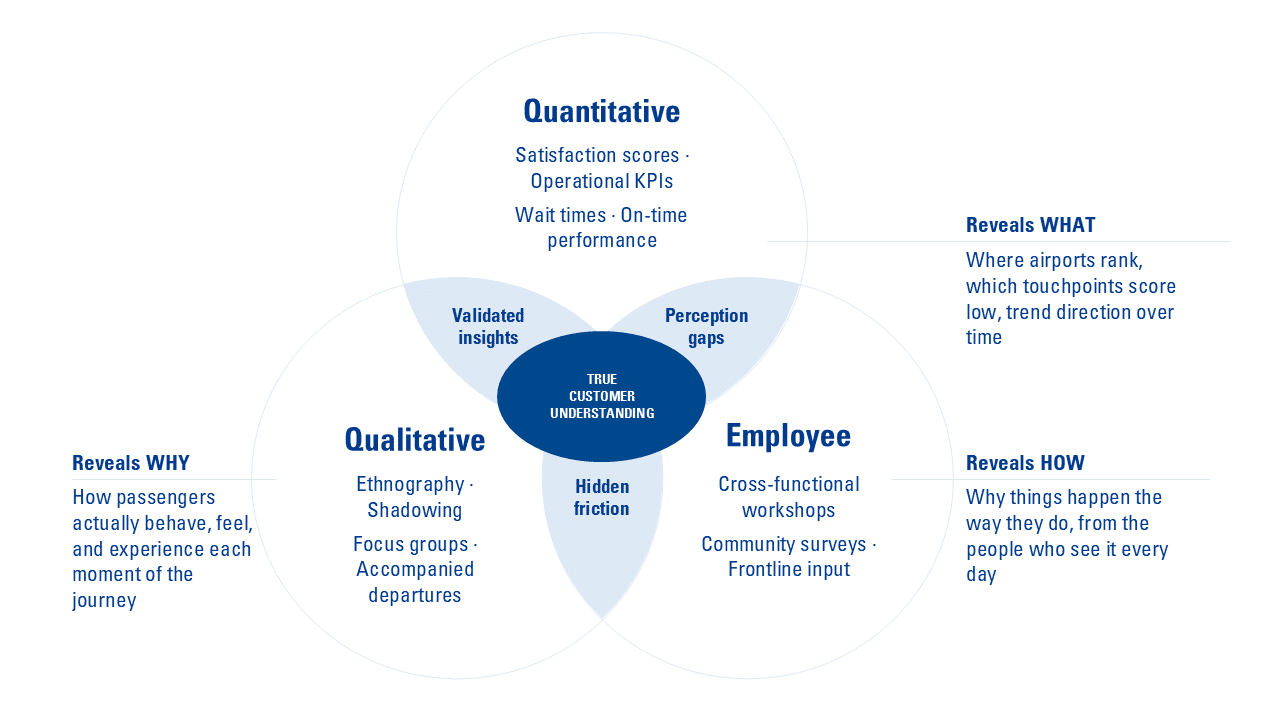
Quantitative data tells you what is happening. Qualitative research tells you why. Employees tell you how.
The Triangulation Model
Cross-referencing prevents misinterpretation and moves airports from scores to genuine understanding.
How to turn airport customer understanding into action?
Understanding passengers is only valuable when it changes decisions. The airports leading in passenger experience management translate insight into investment priorities and operational targets.
Structured update cycles and operational KPIs
At BLR, customer understanding is translated into operational KPIs with hard targets. First baggage must reach the belt within 11 minutes and last baggage within 21 minutes for domestic arrivals. For international arrivals, the corresponding targets are 11 minutes and 40 minutes, measured from ONBL (on-block time). Between 85% and 90% of deliveries meet these standards. BLR also monitors sentiment through its complaint-versus-compliment ratio, providing a continuous signal of how passengers feel about their experience.

Vienna Airport refreshes its customer journey maps each year, layering ACI persona baselines with accompanied departure findings, persona-segmented survey scores, categorized comments, and focus group insights. The updated maps feed into the Passenger Quality Program, a cross-functional forum sponsored by the COO and attended by all division heads, ensuring that the people who allocate resources work from the same understanding of the passenger.
A critical element in any airport customer experience program is closing the feedback loop. It is not enough to gather insight and act on it. The next step is measuring whether the action actually improved the passenger experience. Without that loop, improvement efforts stay disconnected from results.
Persona-based prioritization
When understanding reaches the persona level, investment decisions become specific. Vienna Airport’s journey maps for The Devoted Parent and The Experienced Professional, built on the ACI ASQ Barometer passenger profiles, have driven distinctly different choices. Even within the business traveller category, The Experienced Professional and The Optimistic Colleague have different expectations, demonstrating why personas matter more than broad categories.
- Families (The Devoted Parent) receive Kids Zones, a free stroller service, and dedicated family bathrooms
- Business travelers (The Experienced Professional, The Optimistic Colleague) receive charging stations, reliable Wi-Fi, and quiet working spaces
Each traces back to a specific insight from a journey map or accompanied departure, grounded in what matters most from the passenger’s perspective.
ASQ Personas
| Persona | Key needs | Potential solutions and opportunities |
|---|---|---|
| The Easygoing Enthusiast Largest segment, ~37%; mainly Gen Z and Millennials | Personalization, digital convenience, enjoyable and shareable experiences | Mobile app journey, biometrics, opt-in data exchange for tailored offers, gamified touchpoints, immersive retail and entertainment zones |
| The Devoted Parent Families | Safety, ease, family amenities | Kids zones, free stroller service, dedicated family bathrooms |
| The Destination Driven Leisure, trip-focused | Efficient process, predictability, low stress before takeoff | Clear wayfinding, fast track and self-service options, real-time flight information, calm pre-boarding zones |
| The Experienced Professional Business travelers | Speed, connectivity, focus | Charging stations, reliable Wi-Fi, quiet working spaces |
| The Optimistic Colleague Business travelers | Social, collaborative environment | Differs from The Experienced Professional despite same broad category — social seating, collaborative zones, communal amenities |

Where to start: A customer understanding checklist
Whether your airport is building its foundation or already integrating multiple sources, this checklist can guide your next steps toward a stronger airport customer experience program.
Audit your listening architecture. Can you capture unvoiced behaviours and emotional states, not just satisfaction scores?
Move from process maps to experience maps. If your journey maps omit how passengers feel and where friction occurs, they are process maps, not experience maps.
Move beyond classification to behavioral segmentation. Group passengers by shared behaviours and needs, not just demographics. Bring segments to life as personas with names, stories, goals, and emotional arcs.
Set a refresh cycle. Annual updates are the minimum, fed by multiple sources: surveys, observations, employee input, and customer sessions.
Share the voice of the customer broadly. Organization-wide sharing of both compliments and complaints builds collective ownership of the experience.
Look ahead. The most mature airports work on a prospective view of future customer profiles and journeys, using those insights to inform master-planning and innovation.
Customer Understanding Maturity Spectrum
Where does your airport sit on the journey from data collection to genuine understanding?
The foundation for everything that follows
Customer understanding is the first pillar of airport experience management for a reason. Airports that invest in genuine listening architecture, combining observation, employee engagement, persona-based thinking, and strategic use of ASQ data, build the organizational muscle to keep learning and connect what they learn to the decisions that shape the passenger experience every day.
As demonstrated by BLR and Vienna Airport, whose commitment to evidence-based airport customer experience practices is recognized through their participation in the ACI ASQ program and the Airport Customer Experience Accreditation, the journey from data collection to genuine understanding is both achievable and transformative.
Where does your airport sit on the customer understanding maturity spectrum? Use the checklist and framework in this article to identify the capabilities needed to move to the next level.
The next article in this series turns to the second pillar: how airports translate customer understanding into a coherent experience strategy.
Frequently Asked Questions
What is airport customer understanding?
Airport customer understanding is the organizational capability to systematically learn who passengers are, what they expect, and what drives their experience at every stage of the journey. It goes beyond satisfaction measurement to include ethnographic observation, employee engagement insights, and persona-based analysis.
What is a listening architecture?
A listening architecture is a deliberate mix of complementary research methods, including observation, structured feedback collection, and employee engagement, that together reveal what no single source of passenger data could. It forms the foundation of effective airport customer experience management.
How does the ASQ program support customer understanding?
The ASQ program surveys over 700,000 passengers annually across more than 400 airports. When airports triangulate ASQ scores with qualitative research and employee insights, they move from descriptive statistics to strategic intelligence that drives real improvements in passenger experience.
What are airport passenger personas?
Passenger personas go beyond demographic segments to give traveller types a name, a story, goals, frustrations, and an emotional arc. ACI Passenger Personas provide a standardized framework that airports like Vienna Airport use to design differentiated experiences for families, business travellers and other passenger types.
What is the Airport Customer Experience Accreditation?
The Airport Customer Experience Accreditation recognizes airports that have built structured, evidence-based approaches to understanding and improving the passenger experience. It provides a maturity framework that guides airports from foundational data collection to prospective customer intelligence.
How do airports use employee feedback to improve passenger experience?
Frontline staff observe passenger behavior that surveys never capture, for example, repeated questions at signage points, recurring confusion at junctions, quiet frustrations in queues. Airports like BLR and Vienna Airport formalize this through cross-functional workshops and community-wide surveys, then compare employee perceptions with ASQ passenger scores to identify gaps between operational reality and passenger experience.
What is the difference between a passenger segment and a passenger persona?
A passenger segment groups travelers by shared demographic or behavioural characteristics. A passenger persona goes further. It gives that segment a name, a story, specific goals, emotional states at each journey stage, and distinct frustrations. Personas make it possible to design for a real traveller, not a statistical category.
How often should airports update their customer journey maps?
Annual updates are the recommended minimum. Leading airports like Vienna Airport refresh journey maps each year, layering new ASQ data, accompanied departure findings, focus group insights, and employee input to ensure maps reflect current passenger expectations rather than becoming historical artefacts.
Definitions
Voice of Customer (VoC): The full range of feedback passengers share, structured and unstructured, solicited and unsolicited, across every stage of the airport journey.
Listening architecture: A deliberate combination of satisfaction surveys, observational research, and employee engagement designed to reveal passenger insights no single source could provide.
Passenger persona: A data-grounded traveller profile with a name, goals, frustrations, and emotional arc, used to design differentiated airport experiences.
Customer Understanding Maturity Spectrum: A framework for assessing an airport’s current capability to gather, interpret, and act on passenger insight, from basic data collection to prospective intelligence.
related articles






comments