

As part of the ASQ Program’s 20th Anniversary, this article launches a series on the evolution of airport experience management. Building on two decades of Airport Service Quality (ASQ) measurement, it explores how airports can manage the passenger journey as an integrated system.
Passengers do not evaluate their journey in isolated moments. They experience the airport as a single continuum. A queue at security, the clarity of wayfinding, the responsiveness of staff, the comfort of waiting areas, and the coordination between stakeholders collectively shape perception. For passengers, it is one journey. Within airports, however, these elements are often managed separately.
This article introduces a structured approach to managing the airport experience as a system and marks the beginning of a series exploring each domain in greater depth.
Executive Summary
Airport experience management requires a structured, system-wide approach to managing the passenger journey across the airport ecosystem. The ACI Airport Experience Management Framework integrates strategy, measurement, operational improvement, governance, and collaboration into a continuous management discipline that delivers measurable performance outcomes.
What Does It Mean to Manage the Airport Experience as a System?
Navigating this complexity requires more than operational excellence. Airports must strengthen efficiency while creating meaningful moments that resonate both rationally and emotionally. The airport experience rests on two interconnected components: execution and management. While the passenger journey itself is inherently integrated, airport experience management is frequently fragmented.
Improving individual touchpoints is necessary. Managing the airport experience as an integrated system is transformational.
The ACI Airport Experience Management Framework
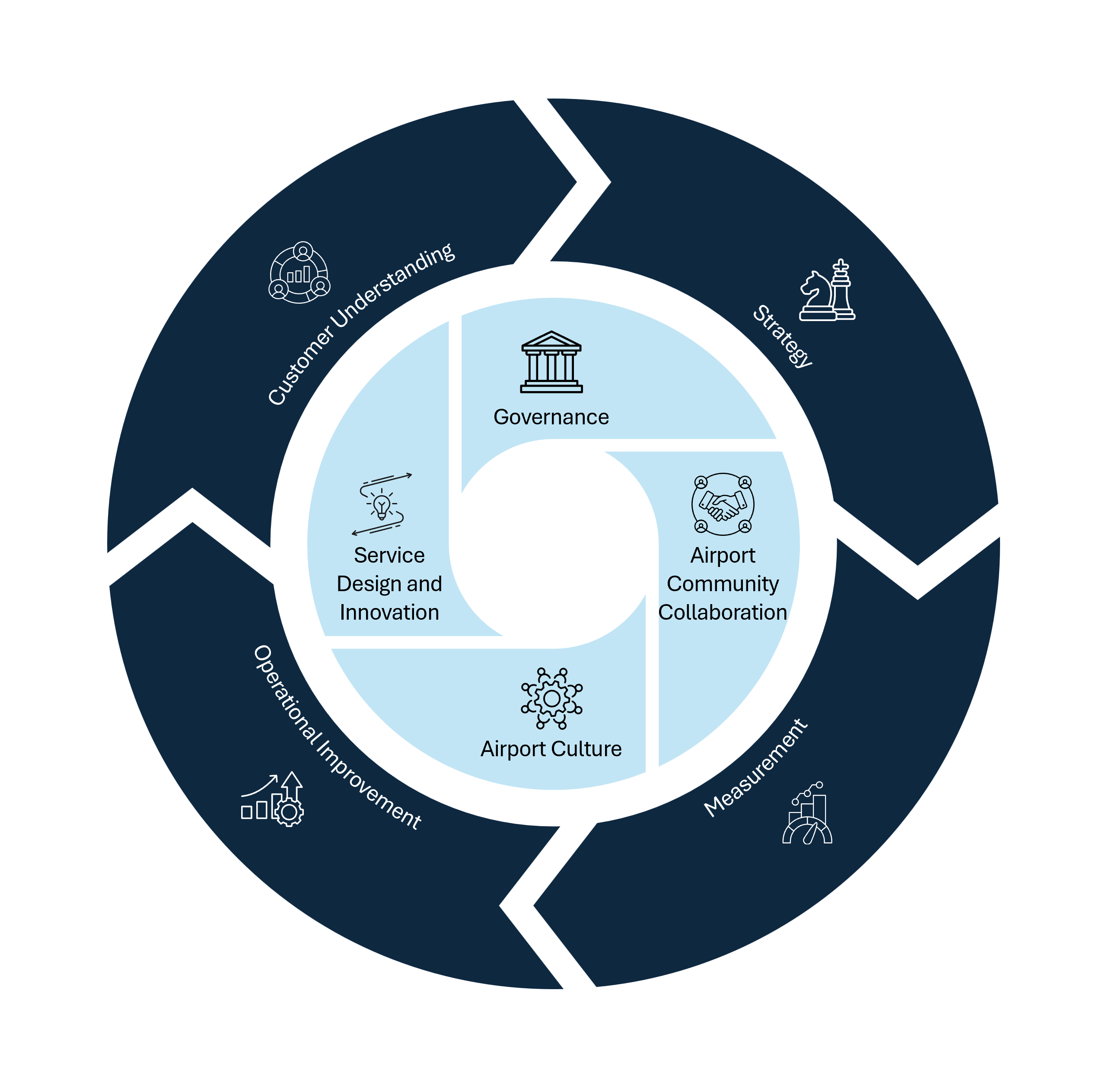
The ACI Airport Experience Management Framework provides this structure.
Grounded in the operational reality of airports, it brings coherence to complexity. Airport experience management is the disciplined, cross-functional effort to design, measure, and continuously improve the passenger journey across the entire airport ecosystem — intentionally, not incidentally.
The framework combines two essential elements:
- A continuous performance management loop: At its core lies a structured cycle of understanding, defining, measuring, and improving the airport experience.
- Organizational pillars that embed experience across the airport ecosystem: Surrounding this cycle are structural domains that ensure alignment across governance, culture, innovation, and community stakeholders.
The ACI model, with its hybrid architecture, recognizes that airports are coordinated ecosystems rather than single entity organizations. Managing the airport experience therefore requires both operational rigor and cross organizational alignment.
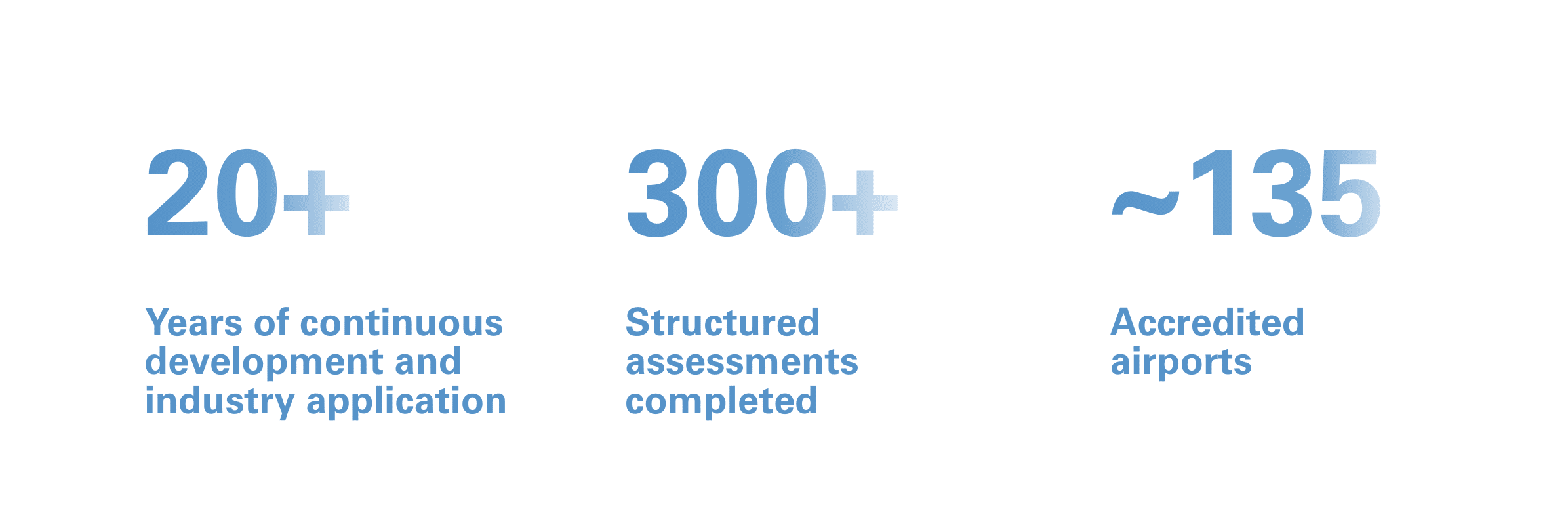
The framework reflects over 20 years of continuous industry development, more than 300 structured assessments, and approximately 135 accredited airports worldwide.
These figures reflect the increasing adoption of structured airport experience management and its alignment with measurable performance outcomes. More importantly, they demonstrate that managing experience as a system delivers measurable impact when applied consistently.
So, what differentiates this approach is its operating logic.
How the Airport Experience Management Framework Works
At the heart of effective airport experience management lies a continuous cycle: understanding, defining, measuring, and improving.
Customer Understanding: The Foundation of Airport Experience Management
“Customer understanding goes beyond statistics. It requires empathy. It is not a reporting exercise but the starting point of effective airport experience management.”
Common gaps in customer sentiment measurement
Many airports measure extensively. Surveys are conducted. Scores are tracked. Dashboards are filled. Yet common gaps remain:
- Data is not always representative
- The wrong questions are sometimes asked
- Insights stay descriptive rather than analytical
Passengers experience the airport as a journey — not as isolated metrics. A modern facility can still disappoint if expectations are misunderstood.
What effective customer understanding requires
Airports should capture both voiced and unvoiced feedback through:
- Passenger satisfaction surveys
- Complaints and comment analysis
- Observation and shadowing
- Journey mapping
- Persona development
- Focus groups and employee workshops
Value comes from deep analysis that identifies emotional drivers, segment specific expectations, friction points, and behavioral patterns.
Equally critical is internal alignment. Insight must be shared across all relevant stakeholders. Without a common understanding, decisions are driven by assumption rather than evidence.
Strategy: Translating Passenger Insight into Airport Experience Strategy
“A winning airport experience strategy is not framed on a wall. It is lived by the passenger at every touchpoint.”
Strategic insight
Strategy must cover the full passenger journey. It should integrate personas, moments of truth, and the diversity of expectations moving through the airport every day.
Defining the airport promise is not a branding statement. It is a strategic commitment that aligns operations with the brand and ensures that the experience delivered consistently supports what the airport stands for.
Strategy cannot remain conceptual. Slides and statements are not enough. The real test is simple: can passengers feel it?
Strategic discipline
Strategy building must align with the airport’s overall corporate direction and clearly define the experience the airport intends to deliver.
It should be informed by a deep understanding of passenger touchpoints, personas, and moments of truth, ensuring that strategic intent translates consistently across the entire journey.
Strategy should answer three practical questions:
- What should passengers consistently feel at key moments?
- Which experience drivers matter most across segments?
- How should the airport differentiate itself across the journey?
The challenge is diversity. Passengers differ in expectations and priorities. Strategy provides coherence. It guides how the airport adapts by segment while remaining consistent in its intent.
Measurement: Aligning KPIs with Airport Experience Strategy
“Chasing trending KPIs does not improve experience. Measuring what matters does.”
Common pitfalls in management
There is a growing tendency to adopt hyped or trending indicators. Yet measurement must serve purpose, not fashion.
Key Performance Indicators (KPIs) should be selected deliberately. Each one should answer a clear question: Why this KPI and not another?
If it does not support the airport experience strategy or operational priorities, it adds clutter rather than clarity.
What effective management requires
Effective measurement requires:
- Indicators aligned with the airport experience strategy
- Cross-functional KPIs combining operational and satisfaction metrics
- Benchmarking against relevant peer airports while monitoring airport’s own performance
- Clear links to business and operational outcomes
Airport experience management requires disciplined KPI selection. Indicators must be fit for purpose, cross-functional, and relevant to the airport environment. Experience metrics should connect operational performance, satisfaction outcomes, and business results to present a clear and coherent view of impact.
Operational Improvement: Closing the Gap Between Promise and Delivery
“Operational improvement is where the airport promise is tested against reality.”
Customer understanding defines expectations. Strategy sets intent. Measurement tracks performance. Operational improvement closes the gap.
The gap to be closed
Operational improvement aligns four realities:
- What the airport intends to deliver
- What is actually delivered
- What passengers expect
- What passengers perceive
The core question is: Is our strategy visible in daily operations?
What structured improvement requires
Operational improvement requires structure — not isolated fixes. It involves:
- Clear and prioritized improvement roadmaps
- Defined project portfolios linked to experience drivers
- Validation of changes through passenger feedback
- Integration of experience thinking into daily routines
The objective is alignment between expectation, promise, delivery, and perception.
When structured properly, improvement becomes continuous rather than episodic. Gaps are identified, prioritized, and monitored. Actions generate new insights.
Without disciplined improvement, strategy remains intention rather than experience.

The Organizational Pillars That Sustain Airport Experience Management
While the Core Performance Loop defines how airport experience is managed, organizational pillars determine whether it can be sustained. Structure without alignment will not scale.
Governance: Embedding Accountability in Airport Experience Management
“Without governance, experience remains an intention, not an organization-wide commitment.”
A clear strategy is not enough. The organization must be structured to deliver it. Governance mobilizes stakeholders, clarifies roles and accountability, and enables coordinated decision-making across the airport ecosystem. It defines who owns the experience agenda, how decisions are made, and how priorities are aligned.
The central question is simple: Is the structure aligned with the strategy?
There is no universal model. Governance depends on the airport’s business and operational structure. Experience management may sit within commercial, operations, or as a standalone integrated function. The right model is the one that supports the airport’s strategic objectives.
Effective governance requires:
- Defined leadership roles and accountability
- Cross-functional coordination mechanisms
- Executive oversight of experience priorities
- Clear escalation and decision pathways
With structured governance, airport experience management becomes an organized transformation agenda rather than a collection of disconnected initiatives. Without it, even strong strategy and improvement efforts struggle to scale.
Airport Culture: Turning Experience Strategy into Daily Behavior
“Culture is how people behave when no one is watching… experience becomes sustainable when it lives in daily behavior, not in manuals.”
Policies define standards.
Supervisors enforce procedures.
But culture determines what happens when there is no checklist or oversight.
Passengers remember small gestures — a staff member walking a traveller to the correct gate, a cleaner pausing to assist. These moments are rarely scripted. They reflect embedded values.
Sustainable improvement depends on people. Culture embeds experience into:
- Customer service training programs
- Recognition and professional development systems
- Managerial support practices
- Employee experience initiatives
Without culture, experience depends on supervision. With culture, it becomes instinctive.
Service Design and Innovation in the Passenger Journey
“Experience lives in the details. Micro moments shape the macro perception.”
Passengers do not remember processes. They remember moments.
Small details accumulate. Wayfinding clarity. Accessibility cues. Cleanliness. Staff interactions. Each micro moment may seem minor in isolation, yet together they define the airport experience.
Service design requires stepping into the passenger’s shoes and intentionally shaping these touchpoints. When aligned with strategy, incremental improvements create distinctive and innovative outcomes.
Airports must anticipate expectations, not merely react to them. Service design and innovation involve:
- Prototyping and testing new service concepts
- Applying structured design thinking methods
- Engaging passengers and stakeholders in co-creation
- Piloting initiatives before scaling
This approach enables differentiation while limiting risk. Innovation must reinforce the airport experience strategy — not distract from it.

Airport Community Collaboration Across the Airport Ecosystem
“Passengers see one airport. They do not see organizational boundaries.”
The passenger journey is seamless only when every organization involved is aligned.
Airlines, security authorities, retailers, ground handlers, and contractors all shape perception.
Airports operate within a shared ecosystem. Without coordination, gaps emerge — a break in service, a handoff without ownership, an inconsistency in standards. While these may occur between organizations, passengers experience them as one failure.
Effective airport experience management therefore requires:
- Clear communication of experience priorities across stakeholders
- Cross-community coordination mechanisms
- Shared accountability for performance
- Engagement initiatives that foster collective ownership
Consistency across touchpoints depends on collective alignment — not individual excellence.
Airport Experience as a Management Discipline — Key Takeaways
As airport operations grow more complex, managing experience requires the same discipline applied to safety, security, and operational efficiency.
The ACI Airport Experience Management Framework provides:
- An integrated management system
- Cross-departmental alignment
- Defined accountability
- Continuous improvement mechanisms
- Ecosystem-wide coordination
Together, these elements enable airports to manage experience intentionally, systematically, and consistently — not episodically.
A Structured Path Forward for Airport Experience Management
As complexity continues to grow, structured airport experience management will not simply be a differentiator. It will become essential for airports seeking sustainable performance, organizational resilience, and meaningful passenger outcomes.
In the coming articles we will examine the core performance cycle and organizational pillars individually, highlighting practical implementation approaches, lessons learned, and perspectives from airports applying structured experience management across diverse operational contexts.
By sharing concrete practices from across the global airport community, the objective is to strengthen collective capability and support peer learning in managing the airport experience as a system.
related articles







comments