
A case to look at: Malta International Airport has built a structured programme of focus groups involving passengers, employees and stakeholders to broaden its understanding of what different airport users need. Using passenger personas and journey mapping, its customer experience team identifies friction points, prioritises improvements and sustains a culture of continuous improvement, with results that include measurable gains in Airport Service Quality (ASQ) scores.
Quick facts about Malta International Airport Customer Experience Feedback Loop
- Malta International Airport runs 3 passenger, 2 stakeholder and 6 employee focus groups every year
- Passenger personas used by the airport: business passengers, frequent travellers, vacation enthusiasts, tech-savvy passengers, assisted passengers
- Recent outcomes of Malta International Airport’s feedback loop: new wayfinding kiosks and materials, an improved Park East waiting area, a planned children’s play area, accessible adult changing facilities in the upcoming East Expansion
- Measured result: improved ASQ scores following employee training tied to focus group insights

Why Malta International Airport built an airport customer experience feedback loop
When you’re running an airport that is essentially a microcosm of a city, no single team can see or hear everything happening within it, making it difficult to get a complete and honest picture of how things are working in their entirety.
But if the intention is to build an environment that genuinely responds to the needs and expectations of its users, you must actively seek out that knowledge. One thing we have found is that most people are willing to tell you what they think, if you are ready to ask. This is where our unique airport customer experience feedback ecosystem comes into its own.
Malta International Airport’s Customer Experience team runs a continuous and diverse series of focus groups that extend far beyond simply gathering passenger comments. We want to hear directly from employees, stakeholders and retail partners, because their perspectives reveal parts of the airport experience that would never surface through reports or internal data alone. It is one thing to interpret information from dashboards, but another entirely to hear people describe how the airport feels and operates from their point of view.
Building the bigger picture: airport customer experience data in practice
This runs across three passenger focus groups, two stakeholder focus groups and six employee focus groups every year, and there’s a clear method behind it. Each focus group, held both in-person and online, adds a data point to a wider network of listening initiatives. Combined with further information gathered inside the terminal, these insights build a holistic understanding of airport customer experience and, crucially, what different people would like us to improve.
The scope of this exercise is intentional. The variety of perspectives not only maximises the breadth of relevant data but also reveals gaps and oversights that may have gone unnoticed if we had restricted the process to passengers alone.
Most travellers only pass through the airport occasionally or are even visiting the terminal for the first time, so their feedback reflects the experience of a fresh set of eyes. Meanwhile, employees and stakeholders spend far more time in and around the terminal and are often best placed to spot recurring issues or subtle operational challenges that passengers may overlook entirely.
By bridging these different perspectives, we generate more accurate and relevant airport customer experience insights, invaluable to our long-term decision-making.
Journey mapping: airport customer experience personas and touchpoints
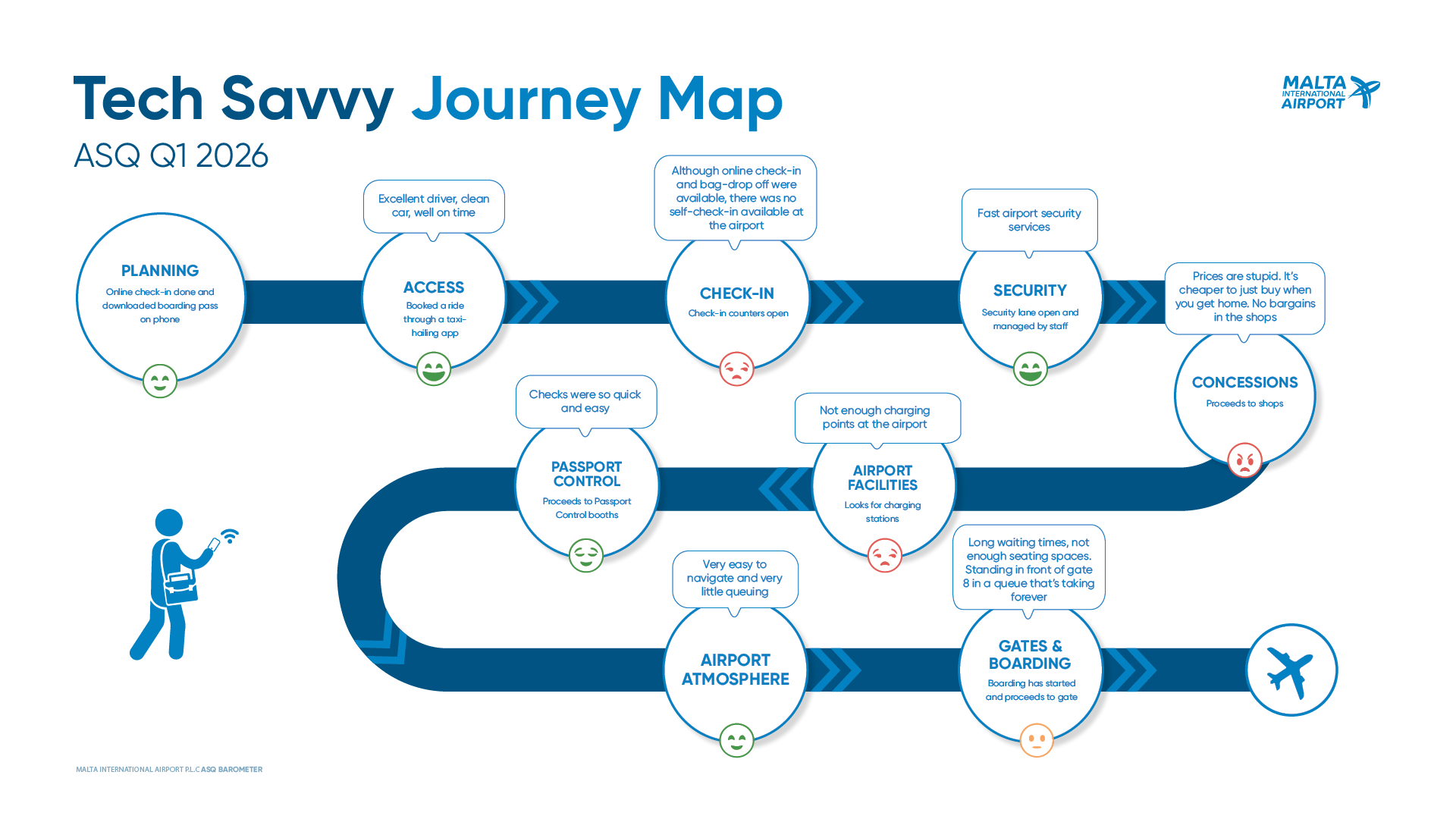
A key part of these focus groups is the use of passenger personas to guide our journey mapping exercises. These personas categorise airport travellers into five distinct categories – business passengers, frequent travellers, vacation enthusiasts, tech-savvy passengers and assisted passengers – each with their own set of priorities, challenges and expectations.
Focus group participants are invited to imagine how these travellers move through every touchpoint of the airport, from kerbside drop-off to boarding. Passengers draw on their own experience, contributing both the emotional and practical observations that come from travelling as an outsider in a controlled environment. Employees and stakeholders are asked to step into each persona’s shoes, identifying friction points, confusing situations or missed opportunities that might not appear from an operational perspective alone.
Journey mapping allows us to keep close tabs on how passenger personas interact with the airport’s touchpoints and gives us a clearer sense of whether our internal expectations align with the real experiences of different traveller types. Crucially, it also helps us prioritise areas for improvement based on a concrete understanding of who is affected, how frequently, and at what stage in their journey.
Turning airport customer experience insight into action
The value of the process shows up in its outcomes. Malta International Airport is investing in large-scale infrastructure to meet both current pressures and future demand.
However, not every improvement needs a major construction project. Focus group insight has already driven a steady stream of smaller, meaningful upgrades: new wayfinding kiosks and clearer wayfinding materials, an improved Park East waiting area suggested by rental car employees, plans for a children’s play area and accessible changing facilities for adults in the upcoming East Expansion, which came following a conversation with the caregiver of an adult with a disability who needs assistance while travelling.
Other initiatives that came about as a direct result of feedback from focus groups include informative activity books for children, additional seating for meet and greet customers as well as a new screen in the staff canteen that displays information about ASQ and the Customer Journey Map.
These examples represent only a fraction of the ideas that have emerged from focus groups and translated into tangible outcomes for our guests. What they demonstrate is that these initiatives are not just checkbox exercises, they are essential tools for continuous improvement.
Sustaining the airport customer experience feedback loop: training and motivation
However, establishing a robust feedback system is not enough by itself, it has to be sustained in order to remain effective. Fostering a culture of continuous improvement means ensuring the loop never stops turning, and that its insights stay grounded rather than abstract, so they positively influence how teams operate on the ground.
That is why, beyond running focus groups, the Customer Experience team leads ongoing training sessions for operators across the airport. An insight is only as valuable as the action it enables, and we are committed to ensuring that employees are equipped with the tools, skills and understanding required to meet our guests’ evolving needs.
And the results speak for themselves. We have observed tangible improvements in ASQ scores following training periods, reinforcing the link between employee development and guest satisfaction.
At the same time, Malta International Airport actively works to engage and motivate employees by recognising their contributions, sharing positive passenger feedback, and involving stakeholders in the wider customer-experience journey. When people feel connected to the outcome, they are more invested in the process.
Frequently Asked Questions
How does Malta International Airport gather customer experience feedback?
Through a rotating yearly programme of three passenger, two stakeholder and six employee focus groups, held in person and online, combined with information gathered inside the terminal.
What are passenger personas, and how does Malta International Airport use them?
Five traveller categories, business passengers, frequent travellers, vacation enthusiasts, tech-savvy passengers and assisted passengers, used in journey mapping exercises to identify friction points at each touchpoint of the airport journey.
What improvements has the feedback programme produced?
Examples include new wayfinding kiosks and materials, an improved Park East waiting area, plans for a children’s play area, and accessible adult changing facilities in the upcoming East Expansion project.
Does the feedback loop measurably improve customer experience?
Yes. Malta International Airport has recorded improved ASQ (Airport Service Quality) scores following employee training tied to focus group insights.
Why include employees and stakeholders, not just passengers?
Employees and stakeholders spend far more time in the terminal and often notice recurring issues or operational friction that occasional passengers miss, adding depth to passenger-only feedback.
related articles






comments